














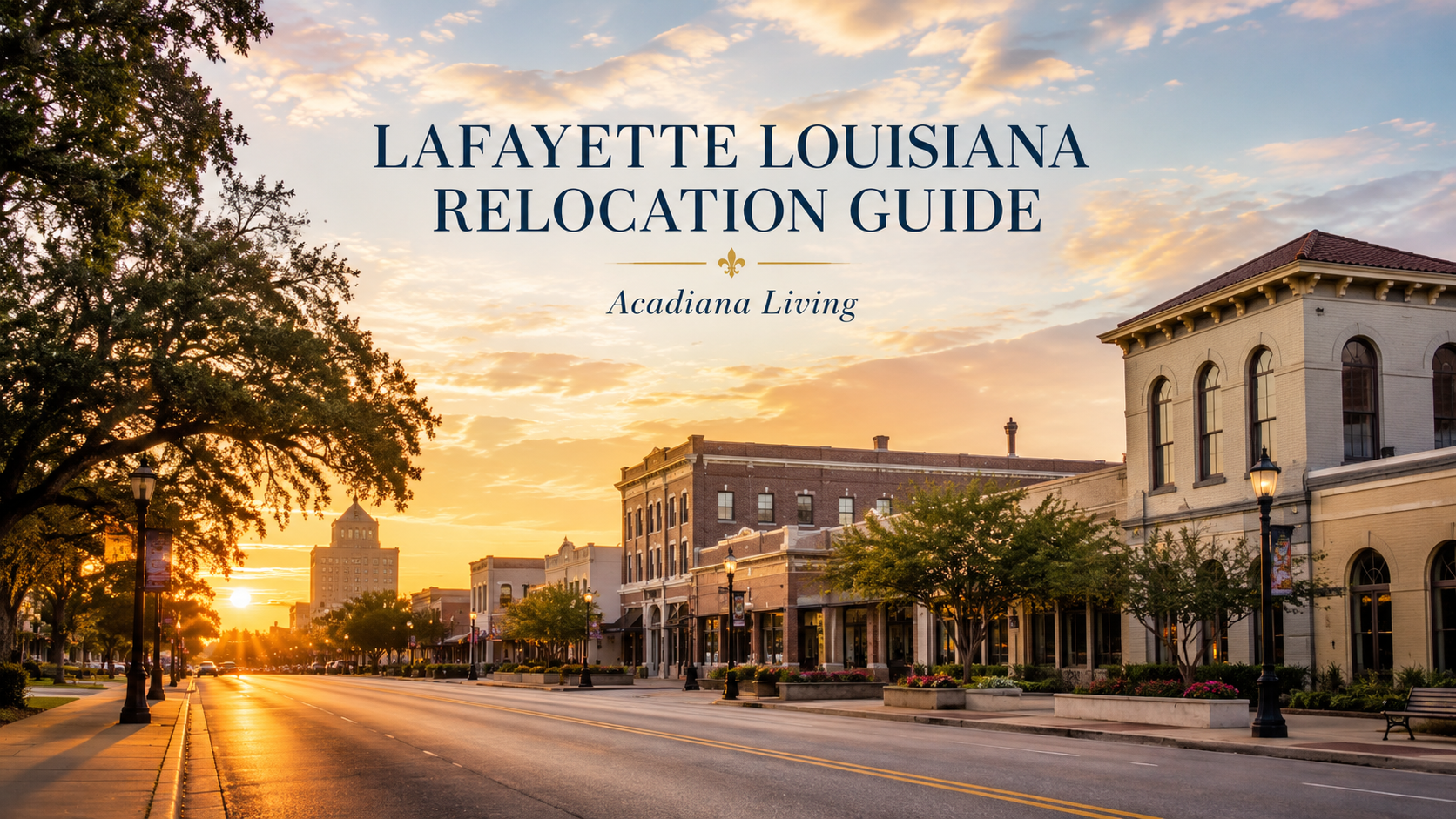
Lafayette, Louisiana combines Cajun culture, regional healthcare, higher education, growing neighborhoods, and a diverse economy. Located in South Louisiana, the city serves as the center of the Acadiana region.
Energy shaped much of Lafayette’s modern growth. However, healthcare, technology, education, manufacturing, finance, and professional services now broaden the economy.
Whether you are moving for work, family, school, or lifestyle, this Lafayette Louisiana Relocation Guide covers the essentials.
Lafayette sits in south-central Louisiana between Baton Rouge and Lake Charles. Interstate 10 provides east-west access, while Interstate 49 connects the area with Alexandria and Shreveport.
Baton Rouge is roughly one hour east. Meanwhile, New Orleans is generally about two hours away, depending on traffic.
Lafayette belongs to the Acadiana region of Louisiana.
Additionally, the city is commonly associated with:
Lafayette Travel describes the community as the heart of Louisiana’s Cajun and Creole Country. Therefore, food, music, language, and local traditions strongly influence everyday life.
Lafayette is close to Broussard, Youngsville, Scott, Carencro, Breaux Bridge, Maurice, Duson, and New Iberia.
These communities provide more housing, school, and property-size options. However, commute times can increase along Ambassador Caffery Parkway, Johnston Street, Verot School Road, and Interstate 10.
Lafayette attracts healthcare workers, educators, engineers, technology professionals, students, tradespeople, and business owners.
Additionally, the city offers strong cultural traditions, local restaurants, festivals, universities, and regional medical services. As a result, newcomers can combine career opportunities with a distinctive South Louisiana lifestyle.
Lafayette offers apartments, townhomes, established houses, newer subdivisions, and larger suburban properties. Housing expenses depend on neighborhood, property condition, flood exposure, and commute location.
Everyday costs include utilities, transportation, insurance, groceries, healthcare, and property taxes. However, flood and homeowners insurance may significantly affect ownership expenses.
Lafayette’s housing market includes historic homes, central neighborhoods, suburban subdivisions, student rentals, and newer developments.
Because conditions vary between properties, buyers should review drainage, flood history, insurance costs, school zones, and road access before purchasing.
Downtown offers apartments, historic buildings, offices, restaurants, galleries, entertainment, and public gathering spaces.
Residents can walk to Jefferson Street businesses, Parc Sans Souci, cultural venues, and community events. Additionally, Downtown Lafayette supports residential, business, arts, and redevelopment programs.
The Saints Streets area sits near downtown and the University of Louisiana at Lafayette.
Housing includes cottages, older homes, apartments, and renovated properties. Because of its central location, the neighborhood appeals to students, professionals, and residents seeking shorter commutes.
Freetown–Port Rico offers older homes, rentals, local businesses, and quick access to downtown and the university.
The neighborhood has a distinctive community identity. However, property condition and street activity can vary, so buyers should research each block carefully.
Broadmoor includes established homes, mature trees, schools, and convenient access to Johnston Street and Ambassador Caffery Parkway.
Additionally, its central location supports easier travel toward shopping, healthcare, and employment areas. Many homes offer a traditional suburban setting within the city.
River Ranch is a planned community with homes, apartments, townhomes, offices, shops, and restaurants.
Walkable streets and mixed-use development attract residents seeking nearby conveniences. However, housing costs and association fees may be higher than in some older neighborhoods.
South Lafayette includes newer subdivisions, apartments, retail corridors, and growing residential communities.
Areas near Kaliste Saloom Road, Verot School Road, East Broussard Road, and Ambassador Caffery Parkway continue developing. Therefore, residents should compare construction activity and commute times before moving.
Youngsville and Broussard sit south of Lafayette and remain closely tied to the regional economy.
Both communities offer newer subdivisions, parks, businesses, and larger residential developments. However, population growth has increased traffic along several connecting roads.
Lafayette’s economy includes healthcare, energy, technology, education, manufacturing, construction, finance, and professional services.
The Lafayette Economic Development Authority assists businesses throughout Lafayette Parish. Additionally, it provides relocation and business-development support for companies entering the region.
Oil and natural gas helped establish Lafayette as a major regional business center.
Today, energy-related careers include:
However, the local economy is no longer dependent on energy alone.
Healthcare remains one of Lafayette’s strongest employment sectors.
Hospitals, clinics, rehabilitation centers, specialty practices, and senior-care providers support jobs in nursing, administration, therapy, diagnostics, and patient services.
Additionally, regional medical facilities serve residents from several surrounding parishes.
Lafayette supports software, telecommunications, engineering, finance, insurance, design, and business-service employers.
Meanwhile, local business programs assist entrepreneurs, contractors, and expanding companies. LEDA promotes small-business resources, bonding assistance, and executive-development programs.
Education employers include:
Together, these institutions support teaching, research, administration, maintenance, and workforce training.
Most public school students in the area attend Lafayette Parish School System.
The district serves nearly 30,000 students and employs more than 4,000 people. Therefore, it is both a major education provider and regional employer.
Families should confirm assigned schools before choosing a home.
Student placement is based partly on a family’s established residence within district boundaries. Additionally, registration requirements may include previous school records, identification, and immunization information.
Lafayette Parish schools include traditional, magnet, career-focused, and specialized programs.
However, applications, attendance rules, transportation, and available space can differ. Families should review current district information before making housing decisions.
Lafayette also offers private, Catholic, religious, and independent schools.
Tuition, admission requirements, transportation, and grade availability vary. Therefore, parents should contact each school directly.
Major higher education options include:
These institutions support engineering, business, healthcare, arts, education, research, and skilled-trade training.
Lafayette serves as a regional healthcare center for Acadiana.
Residents can access primary care, pediatric services, emergency treatment, specialty medicine, rehabilitation, and senior care.
Additionally, clinics and medical offices are distributed throughout central and southern Lafayette.
Lafayette offers shopping centers, boutiques, local markets, national retailers, and neighborhood businesses.
Major commercial areas include:
Because shopping districts are spread across the city, vehicle access remains helpful.
Lafayette’s dining scene is closely connected to Cajun and Creole cooking.
Popular local flavors include seafood, gumbo, boudin, crawfish, étouffée, barbecue, and plate lunches. Additionally, residents can find Vietnamese, Mexican, Mediterranean, Caribbean, and other international cuisines.
Lafayette Travel describes the city as a major destination for Cajun and Creole food. Meanwhile, downtown includes restaurants ranging from casual Southern cooking to international dining.
Lafayette supports live music, theaters, galleries, dance, festivals, and community events.
Downtown venues and the Acadiana Center for the Arts host performances and exhibitions. Additionally, local restaurants and clubs regularly feature Cajun, zydeco, blues, rock, and other music.
Lafayette offers museums, cultural attractions, parks, live music, shopping, and outdoor recreation.
Local tourism resources highlight food, festivals, architecture, wildlife, history, and Cajun and Creole traditions.
Vermilionville presents Acadian, Creole, and Native American history through restored buildings, demonstrations, music, and cultural programs.
The attraction helps residents and visitors understand the region’s settlement, traditions, and daily life.
Acadian Village includes historic homes, traditional architecture, and seasonal events.
Additionally, the site provides another way to explore Acadiana’s cultural heritage.
Downtown supports concerts, festivals, restaurants, public art, and community gatherings.
Events such as Downtown Alive! bring live music into central public spaces. Therefore, downtown remains an important entertainment destination for residents.
Residents can enjoy parks, walking paths, sports fields, playgrounds, golf courses, and nearby nature areas.
Additionally, the Atchafalaya Basin provides opportunities for paddling, fishing, wildlife viewing, and swamp tours within the broader region.
Festivals are a major part of Lafayette’s cultural calendar.
Music, food, Mardi Gras, arts, and heritage events occur throughout the year. As a result, residents have frequent opportunities to experience local traditions.
Lafayette remains primarily car-dependent.
Major routes include:
Traffic can become heavy near Interstate 10, the university, Ambassador Caffery Parkway, and southern growth areas. Therefore, home location can strongly influence daily commute times.
The Louisiana Department of Transportation and Development manages major state routes throughout Lafayette and surrounding parishes.
Its Lafayette District covers Lafayette, Acadia, Iberia, St. Martin, St. Landry, Vermilion, and nearby areas.
Lafayette Transit System provides bus service along selected city routes.
However, service remains more limited than transportation systems in larger metropolitan areas. Most households rely on personal vehicles for work, school, and errands.
Lafayette Regional Airport sits southeast of central Lafayette.
The airport offers connections through larger airline hubs. Meanwhile, Baton Rouge and New Orleans airports provide additional choices within driving distance.
Lafayette has a humid subtropical climate.
Summers are hot, humid, and rainy. Meanwhile, winters are usually mild with occasional freezing temperatures.
Heavy rainfall, hurricanes, tropical storms, tornadoes, and flash flooding can affect Lafayette.
Therefore, buyers should review flood zones, drainage, previous water damage, and insurance costs for every property.
Lafayette can be a strong choice for healthcare workers, educators, energy professionals, students, families, and business owners.
The city combines regional employment with food, music, education, and cultural traditions. Additionally, nearby communities provide more housing and property-size choices.
However, neighborhood selection remains important. Traffic, flooding, schools, insurance, and housing conditions vary throughout the area.
Lafayette offers a distinctive combination of career opportunities, Cajun culture, education, healthcare, and entertainment.
Energy remains part of the city’s identity. However, technology, medicine, education, and professional services continue broadening the economy.
For newcomers seeking opportunity within the heart of Acadiana, Lafayette deserves serious consideration.